Water is the driving force of our gardens, initiating the germination of seeds and then keeping our plants turgid and able to absorb nutrients via their roots and photosynthesise within their leaves. If applied incorrectly it can also be the cause of plant decline, proliferating disease and displacing vital oxygen within your soils. Choosing the correct system for watering your garden will involve you looking at the area, your plants and their needs and your soil type and topography. A slower application of water can be advantageous on sloping sites and on soils that do not readily take in water.
Drippers have been a popular choice for both containers and gardens, the latter typically done with drip-tube over larger garden areas. Their key benefit is that they apply water directly to the soil, avoiding possible losses through wind-drift. Each dripper will have a stated rate of application (e.g. 2L/h) which can be used to work out how long to run them into pots or around your plants by counting the number of drippers over a square metre.
Sprinklers come in a myriad of types and sizes. Larger sprinklers such as impact and gear-driven models can be used over broader garden areas or installed within lawns. Smaller shrub heads can be mounted onto risers to elevate their position so that they are not obstructed by foliage and apply water both over the plants and soil. This can be useful if looking to cool and humidify your garden areas but can also be an issue if growing plants susceptible to fungal disease. Each model will also have a stated application rate that can be used to assist in scheduling (eg. 13mm/h meaning that it would apply 13L per square metre if ran for an hour)
Micro Sprays are one of the easiest to install as a basic DIY project over smaller areas and are also readily available in hardware stores and garden centres. The nozzles can be found in many patterns and are generally mounted onto small, ridged risers of various heights and stakes. As their output is considerably finer than larger sprinklers they are more prone to being affected by wind and any debris that make their way into the lines.
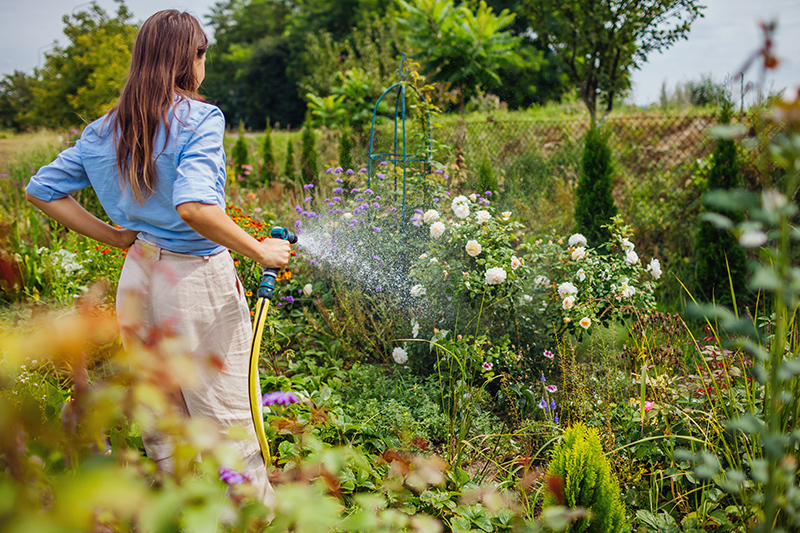
Hand watering can be a great way to connect with your garden, providing useful intel such as pest and disease attack, weed infestations or what’s about to bloom. If using a hose, look for a watering wand with many larger holes such as a Dramm (the type you will see in most garden centres) to speed up the job
TOP TIPS
-
Include an irrigation filter on all systems to help prevent nozzles and drippers from being fouled.
-
No matter what system you choose, all require regular inspection for damage and blockages.
-
Irrigation stores will often assist you in designing a system for your home. They generally require a plan with measurements and the results of a ‘Bucket Test’ where you intend to connect it (Time it takes to fill a 10L bucket with the tap opened fully).
-
If installing an automatic irrigation system be sure to include a rain switch or other sensors to suspend watering when it is not required.
-
Don’t mix sprinkler types and drippers, otherwise you will have inconsistent application
-
It is best to run your irrigation in the morning for optimal absorption and minimise disease.
-
Be sure to adjust your irrigation times to suit the season and your plants needs.
-
Look to run your system longer at greater intervals to encourage a deeper root system
We hope you have enjoyed this article so far.
One of the many benefits of Garden Clinic membership is full access to our website. Members please log in to view the complete articles.
If you are not a Garden Clinic member and wish to access our website as well as enjoy the many benefits of membership, including access to our Helpline 7 days a week, please visit the link below to join us.